
New OECD Guide for Indigenous Peoples Supports Engagements for Corporate Accountability
SIRGE Coalition and Voices have published guidance to help Indigenous Peoples navigate the OECD complaint system as a tool to support communities affected by harmful business practices in defending their rights and holding companies accountable.
Supported by OECD Watch, Indigenous experts, and civil society organizations, including Tallgrass Institute, the guide makes the OECD process more accessible for affected communities and helps Indigenous Peoples make informed decisions about whether and how this mechanism can be useful in their specific circumstances.
What is the OECD and the OECD Guidelines?
The Organisation for Economic Co-operation and Development (OECD) is an international organization made up of governments that work together to create policies and standards on economic growth, sustainability, and social wellbeing. The OECD Guidelines for Multinational Enterprises on Responsible Business Conduct (OECD Guidelines) are recommendations from governments to companies on how to act responsibly. They cover areas such as human rights — including Indigenous Peoples’ rights — the environment and climate change, corruption, transparency, and taxation. In addition to the 38 OECD member countries, 14 non-member countries also follow and promote the Guidelines.
How can Indigenous Peoples engage the OECD?
To address harmful business practices, Indigenous Peoples can draw on a variety of mechanisms to safeguard their rights. These include legal actions, international human rights procedures, and complaint systems that promote corporate accountability. To the latter, the OECD Guidelines set international standards for how companies should operate responsibly. In the 52 countries that adhere to these Guidelines, National Contact Points (NCPs) review complaints and facilitate dialogue or mediation when companies may not be meeting these standards.
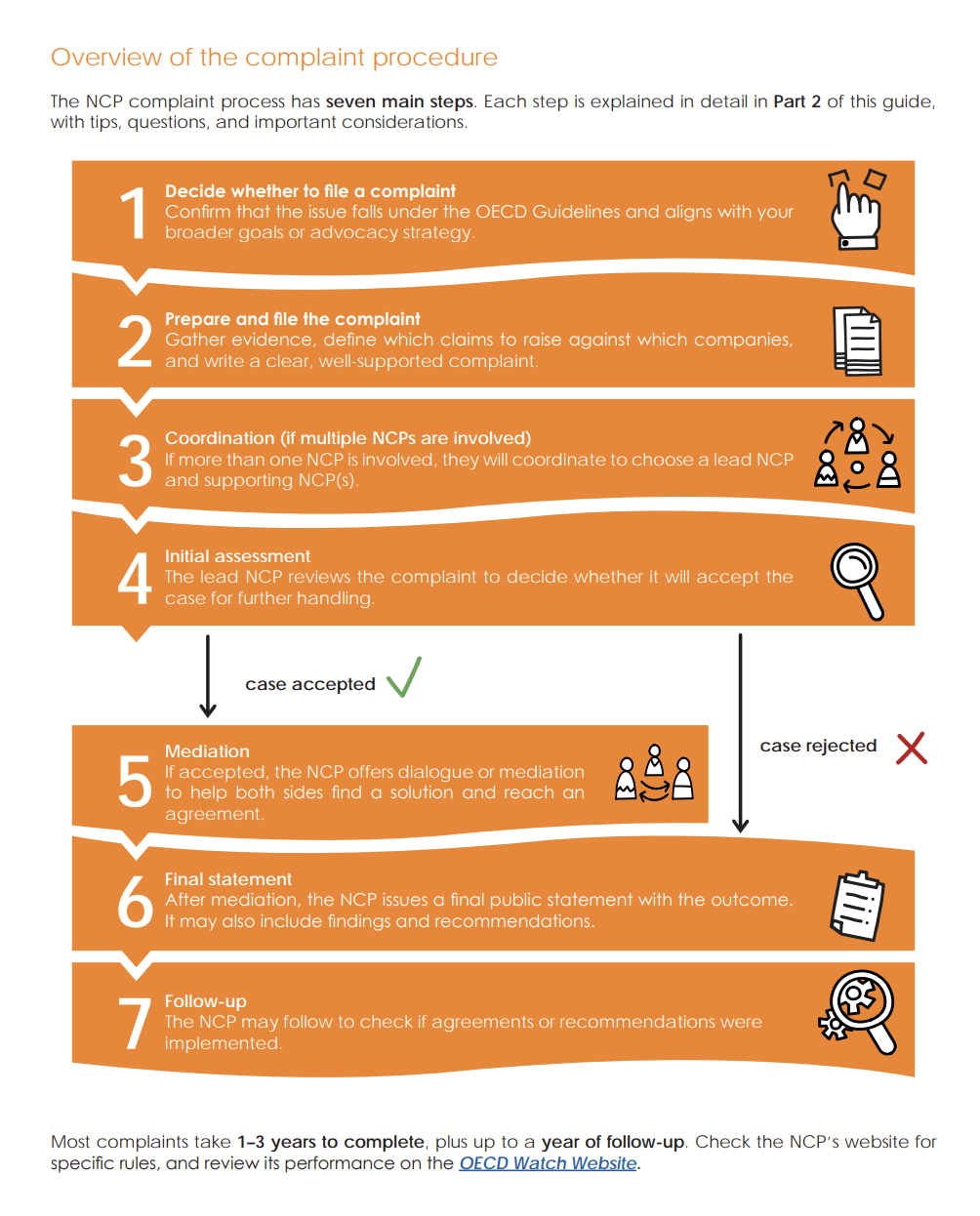
For Indigenous Peoples, this complaint process can serve as an additional—or alternative—pathway to challenge harmful business practices. When integrated into a broader advocacy or defense strategy, it can strengthen efforts to protect rights, lands, and livelihoods. At the same time, it requires careful consideration of its potential benefits and risks.
The guidebook examines the OECD Guidelines in detail; discusses what the complaint mechanisms at NCPs can and cannot offer; helps assess whether and in what cases an OECD complaint is a suitable tool for addressing harmful corporate conduct; outlines the complaint process step by step, with practical tips and examples; and shows how OECD complaints can support broader advocacy and justice strategies when combined with other actions and parallel procedures.
According to Voices, the OECD complaint mechanism is still not widely known among Indigenous Peoples and their frontline communities as a possible — alternative or additional — pathway to defend their territories, livelihoods, and cultural heritage. With this dedicated guide, SIRGE and Voices provide a full and well-informed basis for decision-making, supporting communities as they assess the potential and risks of filing a complaint against a multinational enterprise causing harm.
Download the guide and supporting factsheet, and visit SIRGE Coalition and Voices for more further background and translated materials.