
Indigenous Peoples’ Open Letter to the Russian Federation for the Release of Daria Egereva
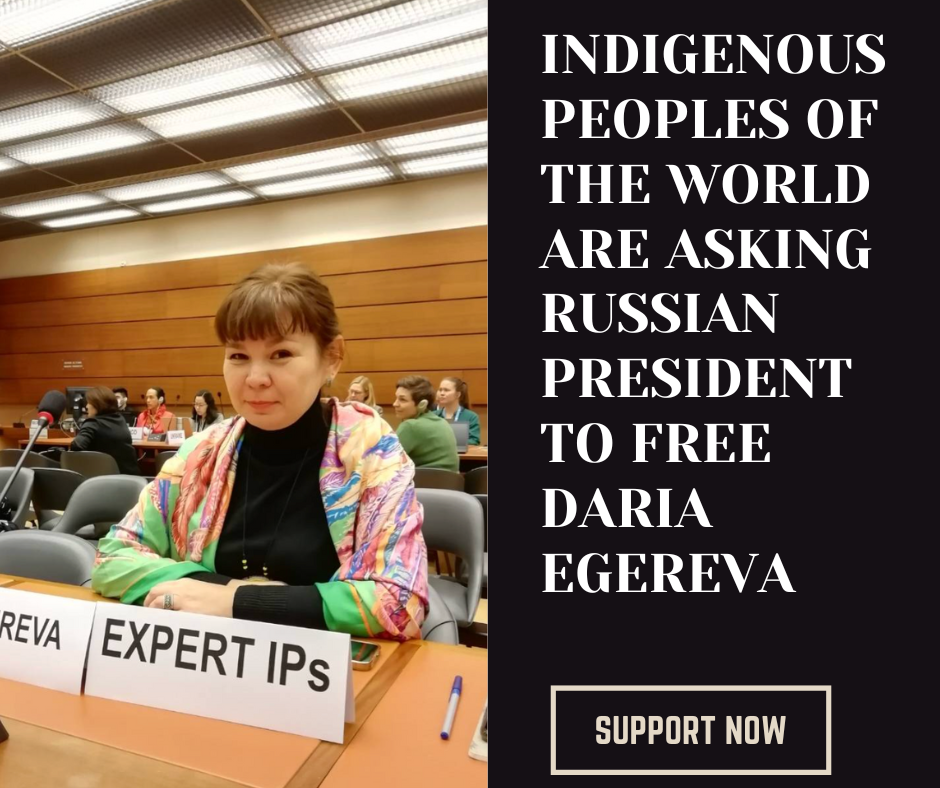
Image via Cultural Survival
Tallgrass Institute supports the open letter and petition from Indigenous Peoples around the world to Russian Federation President Vladimir Putin requesting the immediate release of Daria Egereva, a Selkup leader who was arrested in December and currently awaiting trial in a Russian jail. The letter highlights the important international work Ms. Egereva has done for decades and emphasizes, “Ms. Egereva’s activities were exclusively professional, non-violent, and institutional in nature, firmly grounded in dialogue and cooperation.”
"Daria Egereva is a representative of Indigenous Peoples whose lives are inextricably linked to nature, its conservation, and responsible stewardship for the benefit of future generations,” said Valentina Sovkina (Saami), a member of the United Nations Permanent Forum on Indigenous Issues. “The protection of ancestral territories is a form of peaceful human rights activism aimed at dialogue, mutual understanding, and sustainable development. Daria's love for her native land and responsibility for its preservation have always been and remain a key priority for her work. We are convinced of her innocence and respectfully call for her immediate release."
Ms. Egereva was detained in Russia on December 17, 2025, and accused of participating in a terrorist organization, after her participation at the United Nations Climate Change Conference (COP30) in Belem, Brazil. She represents the Selkup Nation, one of the smallest Indigenous Peoples in Russia, with a total population of 3500, holds the role of Co-chair of The International Indigenous Peoples Forum on Climate Change (IIPFCC), is a former member of the Facilitation Working Group of the Local Communities and Indigenous Peoples Platform (LCIPP) under the UNFCCC, and a long-standing participant in the international Indigenous Peoples movement.
Signatures to the letter include a number of International Indigenous caucuses made up of Indigenous Peoples and organizations from the seven United Nations socio-cultural regions working in forums on climate change, heritage, plastics, mercury, environment, and sustainable development. Regional caucuses include Africa, Arctic, Asia, Latin America and the Caribbean, and North America.
Delivered in anticipation of a hearing scheduled for February 11, the letter closes with an appeal to “a commitment to the principles of human dignity, proportionality, and peaceful, professional dialogue, as reflected in internationally recognized human rights standards.” The accusation carries a potential prison sentence of 10 to 20 years
Read further background courtesy of Cultural Survival and the full letter in English and Russian.