
Indigenous Organizations’ Recommendations to Strengthen IFC Performance Standard 1
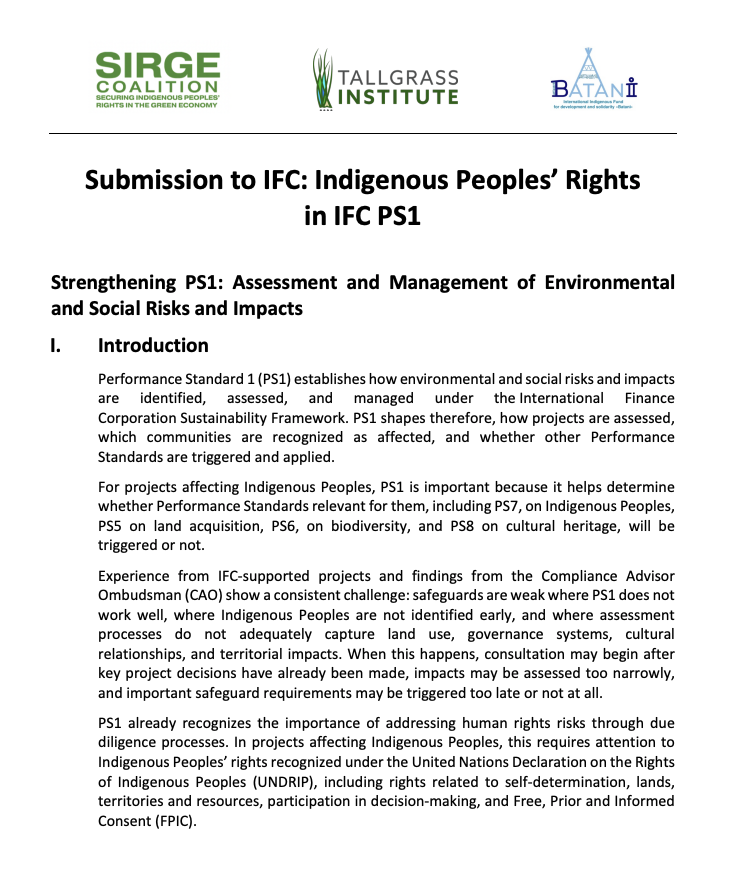
As the private sector lending arm of the World Bank Group, the International Finance Corporation (IFC) is currently reviewing its Sustainability Framework, with updates to its Performance Standards expected in 2028. Today Batani Foundation, SIRGE Coalition, and Tallgrass Institute delivered recommendations to strengthen IFC’s Performance Standard 1 - Assessment and Management of Environmental and Social Risks and Impacts (PS1). This submission follows a previous submission about what is required to strengthen PS5 and PS7.
For projects affecting Indigenous Peoples, PS1 is important because it helps determine whether Performance Standards relevant for them, including PS7, on Indigenous Peoples, PS5 on land acquisition, PS6, on biodiversity, and PS8 on cultural heritage, will be triggered or not.
According to the submission, “Experience from IFC-supported projects and findings from the Compliance Advisor Ombudsman (CAO) show a consistent challenge: safeguards are weak where PS1 does not work well, where Indigenous Peoples are not identified early, and where assessment processes do not adequately capture land use, governance systems, cultural relationships, and territorial impacts. When this happens, consultation may begin after key project decisions have already been made, impacts may be assessed too narrowly, and important safeguard requirements may be triggered too late or not at all.”
This submission recommends measures to strengthen PS1 so that Indigenous Peoples are identified early, safeguard applicability is clearly determined, and project decisions are informed by meaningful participation and full consideration of Indigenous Peoples’ rights, governance systems, and territorial relationships. Recommendations include:
1. Establish a mandatory and auditable screening process for identifying Indigenous Peoples and determining safeguard applicability
2. Require early engagement and a formal determination of PS7 applicability
3. Require methodologies that adequately capture Indigenous land and territorial systems
4. Require broader assessment of area of influence, associated facilities, cumulative impacts, and supply chains
5. Ensure integrated application of Performance Standards, especially PS7, PS5, PS6, and PS8
6. Establish clear decision thresholds and pause conditions
7. Require independent verification in high-risk or contested contexts
8. Require assessment of contextual risks and conditions for valid engagement and meaningful consultation and consent
9. Define adequacy criteria for government-led processes
10. Ensure continuity of safeguards, monitoring, and accountability across the project lifecycle
The submission concludes:
Indigenous Peoples must be recognized as rights-holders, not only stakeholders. Baseline data must adequately capture land, resource systems, and governance structures. Safeguard applicability must be determined clearly and based on verifiable evidence. It also depends on timing. Safeguards must be triggered early enough to shape project design. Where identification is incomplete, data is insufficient, or engagement cannot be meaningfully undertaken, the conditions for informed decision-making are not in place. […] Most importantly, PS1 must establish clear conditions for project approval and identify situations where projects cannot proceed. This includes situations where Indigenous Peoples have not been properly identified, impacts have not been adequately assessed, or where Free, Prior and Informed Consent (FPIC) is required but has not been obtained.
Learn more about Indigenous Peoples and the IFC.