
Declaration Urges Countries, Corporations to Protect Indigenous Peoples in Isolation
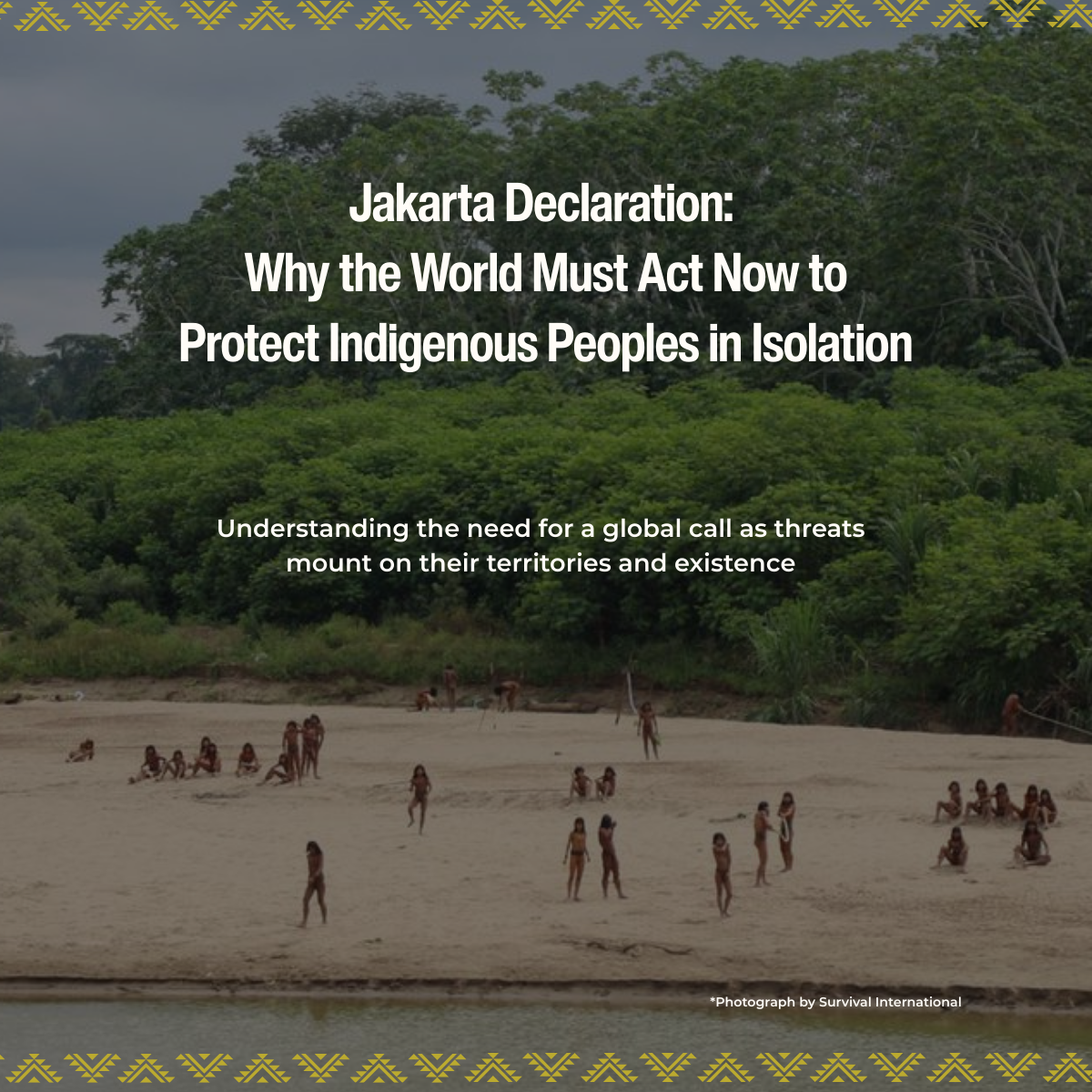
Written collectively and endorsed by 28 organizations from across the world, the Jakarta Declaration outlines a set of calls on countries, multilateral Institutions, national and international financiers, and global supply chains to take concrete and urgent action to protect the rights of Indigenous Peoples in Isolation.
The Declaration urges companies, financial institutions and supply chains specifically “to cease all financing of projects that threaten Indigenous territories, natural resources, and Indigenous knowledge systems, particularly those of Indigenous Peoples in Isolation.”
This is in addition to requests for countries and multilateral institutions to:
Recognize, respect, and protect the existence of Indigenous Peoples, particularly Indigenous Peoples in Isolation, as the legitimate owners of their Indigenous territories, natural resources, and knowledge, with full rights to determine their own ways of life.
Cease all forms of forced contact, exploitation, criminalization, and violence against Indigenous Peoples in Isolation, whether carried out by states, corporations, including missionaries, adventure tourists, and influencers, or other actors.
Guarantee absolute protection of Indigenous territories, natural resources, and knowledge, particularly those of Indigenous Peoples in Isolation, by affirming that for Indigenous Peoples in Isolation, the right to Free, Prior and Informed Consent (FPIC) must be interpreted and applied as a principle of non-intervention in their territories and in the exercise of their rights.
Establish specific policies on protection mechanisms, including the designation of Indigenous territories, particularly those of Indigenous Peoples in Isolation, as No-GoZones.
Revoke and halt all permits and activities related to extractive industries and other projects that may threaten the safety and survival of Indigenous Peoples, particularly Indigenous Peoples in Isolation.
“Indigenous Peoples Living in Voluntary Isolation are activating their core right to self-determination, which must be respected through the principles laid out in the Jakarta Declaration,” said Kate R. Finn, Founder and Director of Tallgrass Institute, a signatory to the declaration and participant in the Indigenous Knowledge Exchange that took place in Jakarta where the declaration was drafted. “This delegation brought together the collective wisdom, expertise and experience of Indigenous Peoples from Indonesia and South America where the largest populations of Indigenous Peoples in Isolation live, to build strategies for their protection. Companies must cease financing and developing projects that diminish the water and land on which these communities rely, and investors and allies, through this Declaration, have a new roadmap to safeguard their rights.”
Who are Indigenous Peoples in Isolation?
Indigenous Peoples in Isolation are Indigenous communities that consciously choose to live separately from, or without maintaining sustained contact with, the outside world. As a result, they face extremely high levels of vulnerability to violence, territorial dispossession, disease, and the physical, cultural, and collective knowledge extinction of their peoples.
Indigenous Peoples in Isolation as legitimate owners of their lands and territories: Indigenous Peoples in Isolation are the legitimate owners of their Indigenous lands and territories, natural resources, and knowledge, with full rights to determine their own ways of life.
Rights of Indigenous Peoples in Isolation: Indigenous Peoples in Isolation have a right to Self-determination, including the right to choose to remain uncontacted and free from forced contact, assimilation, and cultural destruction.
Full territorial protection and establishment of No-Go Zones: The territories of Indigenous Peoples in Isolation must be fully protected and designated as No-Go Zones, free from extractive industries, infrastructure, and other harmful activities.
Revocation and immediate halt of extractive activities that threaten Indigenous Peoples in Isolation:States must revoke and halt extractive, infrastructure, and other projects and activities that threaten the safety and survival of Indigenous Peoples in Isolation.
FPIC in the context of Indigenous Peoples in Isolation: For Indigenous Peoples in Isolation, free, prior and informed consent (FPIC) must be interpreted as a principle of non-intervention in their territories and the exercise of their rights.
Call on financial institutions and global supply chains: National and international financial institutions, companies and global supply chains must cease all financing of projects that threaten Indigenous Peoples in Isolation, their territories, natural resources, and knowledge systems.
Protection as a State obligation: The protection of the rights, dignity and future of Indigenous Peoples in Isolation is a State obligation that must be implemented based on Self-determination, the principle of non-contact, the precautionary principle, No-Go Zones, FPIC, and the permanent protection of their rights as recognized in the United Nations Declaration on the Rights of Indigenous Peoples and other international human rights instruments.
Further Background and Resources
On January 26-29, 2026, over seventy Indigenous leaders, and civil society representatives from Indonesia, the Philippines, Brazil, Colombia, Peru, Suriname, Paraguay, United States, Russia, Denmark, and the United Kingdom, for the International Indigenous Knowledge Exchange and Solidarity Gathering on Nickel Mining, Territorial Defense, and Indigenous Peoples in Isolation.
This gathering, held at a surging demand for transition minerals and a rapid expansion of nickel extraction in Indonesia, aimed at opening a space of exchange and dialogue around the best practices and relevant international experiences in protecting the rights of Indigenous Peoples in Isolation and Initial Contact, also known in international agreements as PIACI (an abbreviated Spanish-language term, Pueblos Indígenas en Aislamiento y en Contacto Inicial). The Jakarta Declaration is the culminating document from this international gathering.
Galina Angarova, Executive Director of the SIRGE Coalition, which also took part in the exchange said conversations made clear that “the accelerating energy transition is creating new and urgent risks for some of the most vulnerable Indigenous Peoples globally. In follow-up discussions with partners in Indonesia we learned more about the situation of the Hongana Manyawa people, who are Indigenous Peoples in Isolation on Halmahera Island, where 19 nickel mining concessions overlap with their territory. This represents an existential threat. SIRGE co-organized this gathering because the global demand for transition minerals cannot override the rights and survival of Indigenous Peoples. At a time when nickel extraction is expanding rapidly in Indonesia, it was critical to create a space centered on Indigenous voices, to ensure that the energy transition is truly rights-based and does not reproduce extractive harm. Protecting PIACI is not a peripheral issue, it is a litmus test of whether the transition is truly just.”