
Tallgrass Institute’s 2026 AGM Report Examines Shareholder Engagement Trends for Indigenous Peoples’ Rights
As companies move in ever-closer proximity to Indigenous Peoples, whether to their lands, territories and waters, or their languages and cultural property, investor strategies are a critical way to bring visibility to rights-aligned engagements with Indigenous Peoples and to respect their human rights.
Tallgrass Institute’s Indigenous Peoples and the 2026 AGM Season reports that investors filed four shareholder proposals in 2026 regarding the rights of Indigenous Peoples, involving companies in the banking, mining, energy, and automotive sectors in the U.S. and Canada.
“Looking back over the past four years and with the new proposals filed in 2026, shareholder strategies are generating clear momentum towards corporate accountability to Indigenous Peoples that goes beyond compliance and towards shifting policy commitment into policy implementation, says the report.
New proposals addressed issues including “the right to free, prior and informed consent (FPIC), racial equity audits that include assessments of corporate impact on Indigenous Peoples, and corporate accountability for the impacts of financing, operations, and supply chains on Indigenous communities.”
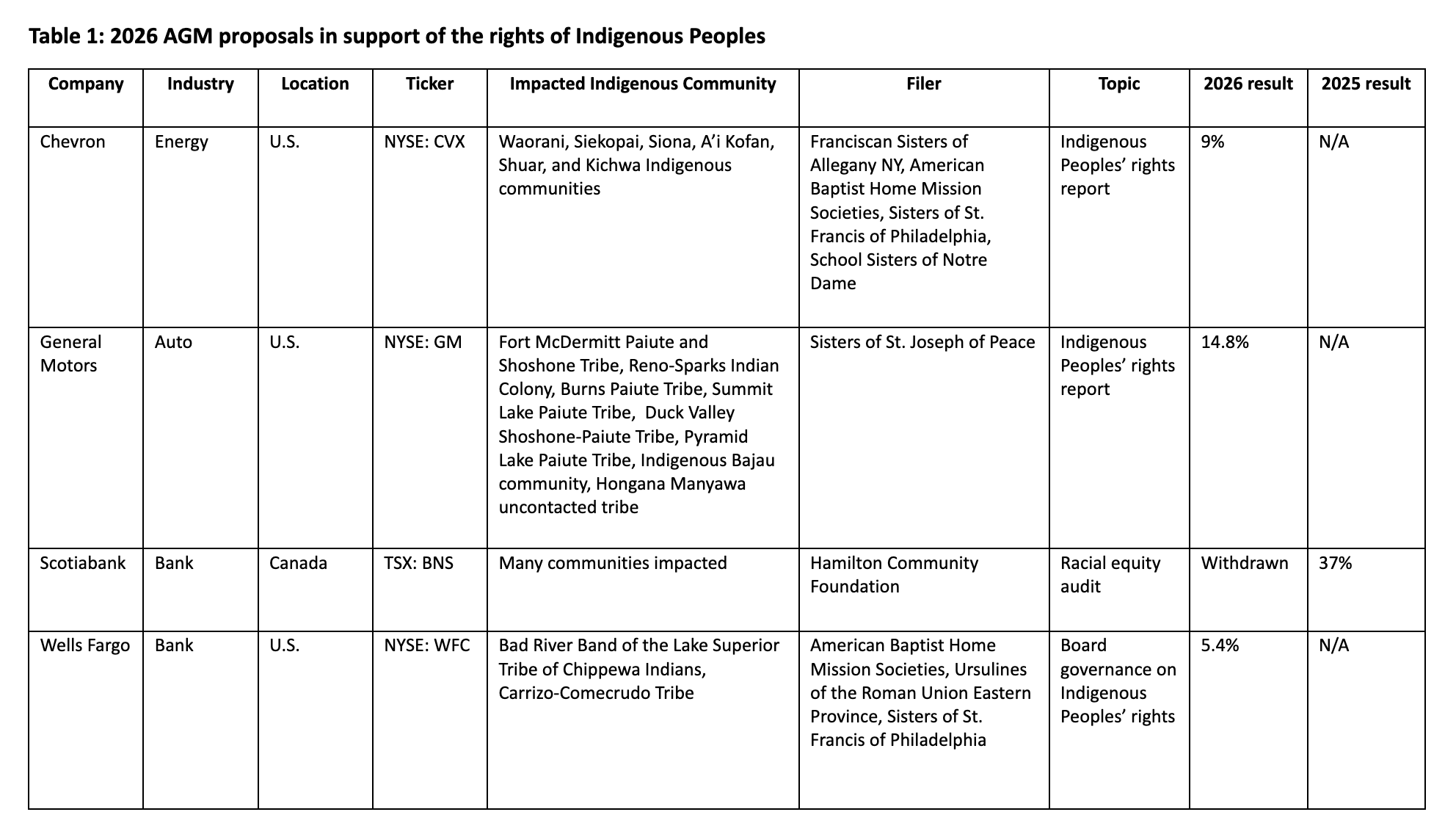
Proposals with General Motors [NYSE: GM] and Chevron [NYSE: CVX] asked for Indigenous Peoples’ rights reports from the companies. Specifically, shareholders wanted GM to describe how it “identifies, assesses, and addresses risks to Indigenous Peoples' rights in the company’s operations and supply chains.” Chevron shareholders wanted to know if the company’s existing commitments are producing meaningful results.
A proposal with Wells Fargo [NYSE: WFC] requested the company establish a standing committee of the Board of Directors focused on Indigenous Peoples' rights, a new strategy after several years of shareholder action on issues involving Indigenous Peoples’ rights impacts.
In Canada, shareholders again asked Scotiabank to publish a racial equity audit analyzing the company’s “impacts on non-white stakeholders and communities of colour,” including Indigenous Peoples. The proposal received strong shareholder support in 2025, and in 2026 the proposal was withdrawn with the company committing to conduct a series of reviews and public reporting in 2026 and 2027.
Canada's six major banks have now completed, committed to, or are undertaking formal reviews of its employment and business practices. “Over the past four AGM seasons, shareholder proposals have helped shift the conversation from whether racial equity and Indigenous reconciliation deserve corporate attention to how financial institutions should measure progress, strengthen accountability, and report publicly on the results,” says the report.
Noting the number of new proposals in the U.S. declined in 2026, regulation reduced the role for the Securities and Exchange Commission in no-action requests, and less support overall for ESG-related proposals, the report concludes:
In a landscape, particularly in the United States, with fewer sustainability and ESG-related proposals going to a vote, these proposals hold a firm line against dilution of past commitments and to ensure that progress towards full respect for Indigenous Peoples has a clear and actionable pathway forward. As companies move in ever-closer proximity to Indigenous Peoples, whether to their lands, territories and waters, or their languages and cultural property, investor strategies are a critical way to bring visibility to rights-aligned engagements with Indigenous Peoples and to respect their human rights.
See also reports from 2025, 2024, and 2023.