
Tallgrass Institute Discusses Indigenous Rights in Benefit Agreements on Native American Calling
Any time there is a negotiation with a private company or a mining company, that company has to understand the context and inertia that they are working with in Indian Country.
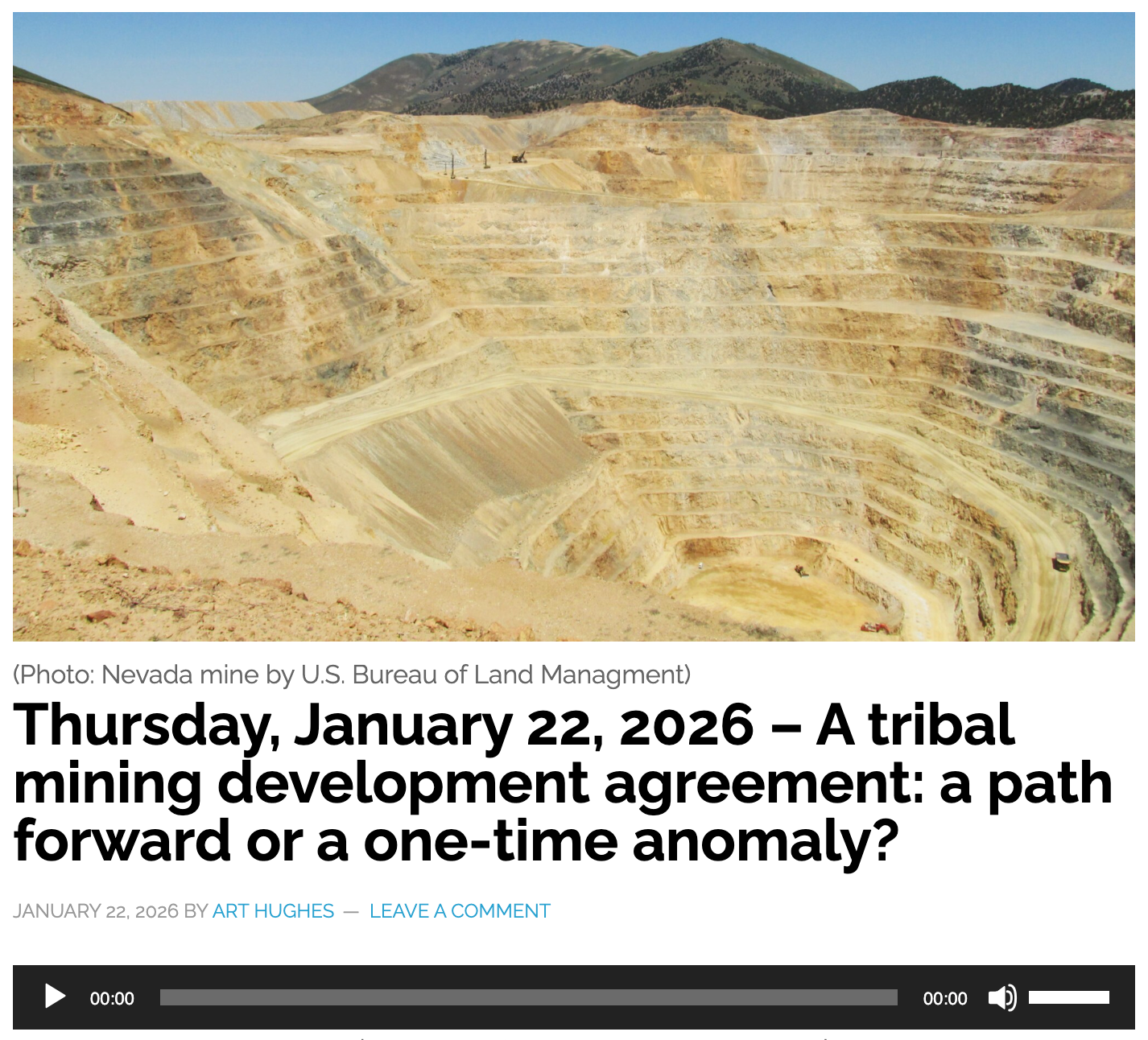
Kate R. Finn, Founder & Executive Director of Tallgrass Institute, and Maranda Compton, Founder and President of Lepwe, appeared on the Native American Calling segment, A tribal mining development agreement: a path forward or a one-time anomaly?, to provide context for a recent benefit agreement between the Shoshone Paiute Tribes of the Duck Valley Reservation and a gold mining company. Tribal Chairman Brian Mason has called the agreement “historic” and discusses on the podcast theways it benefits the Tribe and upholds standards set by the United Nations Declaration on the Rights of Indigenous Peoples.
Finn discussed how benefit agreements with Tribes can do this:
In the Declaration, both Article 20 and 23 talk about Indigenous Peoples' right to pursue their own economic priorities and to have those priorities respected. Community Benefit Agreements and Tribal Benefit Agreements can be a tool to make sure there is equity in participation, equity in decision making, and that those economic priorities that are unique to that land and unique to that Tribe really come forward in the context of mining. Mining is a long-term endeavor. Really focussing on sovereignty and self-determination is a way to bring Community Benefit Agreements to a place of alignment [between] the private sector and Indigenous Peoples.
Compton discusses a critical nuance when creating projects with Tribes where consent is a higher standard than consultation:
[Through our work at Lepwe] we try to find ways to center sovereignty in the process to create better projects so that Tribal nations are not just impacted entities. Tribes are impacted by mines, we are at the tail end of a federal permitting, and we get left with a lot of the negative impacts–a lot of the water and land quality impacts. And we're not involved in the development of planned operations for the mine–how are they actually going to mine, where are the mine facilities going to be. […] Community Benefit Agreements are a recently developed tool that is being used to provide an onramp and an opportunity for Tribes to engage in that development process outside of typically the federal consolation process.
Finn concludes with a global view of benefit agreements and Indigenous Peoples:
Around the world I see that a lot of companies are very interested in implementing [benefit agreements] with Indigenous Peoples and really it all comes back to the UN Declaration on the Rights of Indigenous Peoples and making sure that all engagement with Indigenous Peoples is from a place of respect and a place of consent. Have the Indigenous Peoples consented to the project or have they not? We tell companies they have to spend a lot of time with Indigenous People to know whether this project is going to be a positive development of the community or not. And that happens early on. When engagement is taking place with consent in mind and sovereignty as the north star then there can be real benefits for both Indigenous Peoples and the company.
Finn and Compton are co-authors of Tribal Benefit Agreements: Designing for Sovereignty, with Melanie Matteliano, Research Manager at Tallgrass Institute.
The segment takes place 6:06-40:20 and is bookended by a news segment and a segment that looks at the U.S. Environmental Protection Agency proposal to limit the power of tribes to respond to construction of oil and natural gas pipelines and use of resources by data centers. The quotes above have been edited for clarity.