
Report Examines Consultation with Indigenous Peoples, Chile’s Lithium Expansion and ILO 169
“As Chile advances its National Lithium Strategy, consultation will carry legitimacy only where Indigenous Peoples are engaged early enough to influence the direction of development, participate through their own representative institutions, have access to timely information and independent expertise, and can trace agreements into enforceable obligations and practical results. For companies, investors, and business partners, the completion of a State consultation is relevant evidence, but does not replace independent human rights due diligence or establish consent beyond the measure that was actually consulted upon.” –Implementation of ILO Convention 169 in State-Led Lithium Expansion in Chile: Lessons from the Maricunga Consultation Process
Chile’s state-led lithium expansion raises important questions about how Indigenous Peoples consultation obligations are upheld when a country is both responsible for guaranteeing Indigenous Peoples’ rights and actively promoting lithium development.
Authored by Nalori Chakma and Lesley Muñoz, and published by Tallgrass Institute, Implementation of ILO Convention 169 in State-Led Lithium Expansion in Chile: Lessons from the Maricunga Consultation Process (also available in Spanish) analyzes “issues related to prior consultation, the scope of consultation, Indigenous Colla participation, and the extent to which consultation outcomes are reflected in final legal instruments.”
In 2008, Chile ratified the International Labour Organization’s Indigenous and Tribal Peoples Convention, 1989 (ILO 169), which requires countries to “consult Indigenous Peoples in good faith, through their representative institutions, before adopting measures that may directly affect them and with the objective of reaching agreement or obtaining consent.”
Governance issues and systemic challenges emerged with the launch Chile’s National Lithium Strategy, State-owned enterprises such as the National Copper Corporation of Chile (Corporación Nacional del Cobre de Chile, CODELCO), and the Special Lithium Operating Contract (Contrato Especial de Operación de Litio, CEOL), in the Salar de Maricunga.
According to the community consulted for the report, “the original CEOL was established without prior consultation with the Indigenous Colla communities that inhabit, use, and maintain ancestral relationships with the territory.”
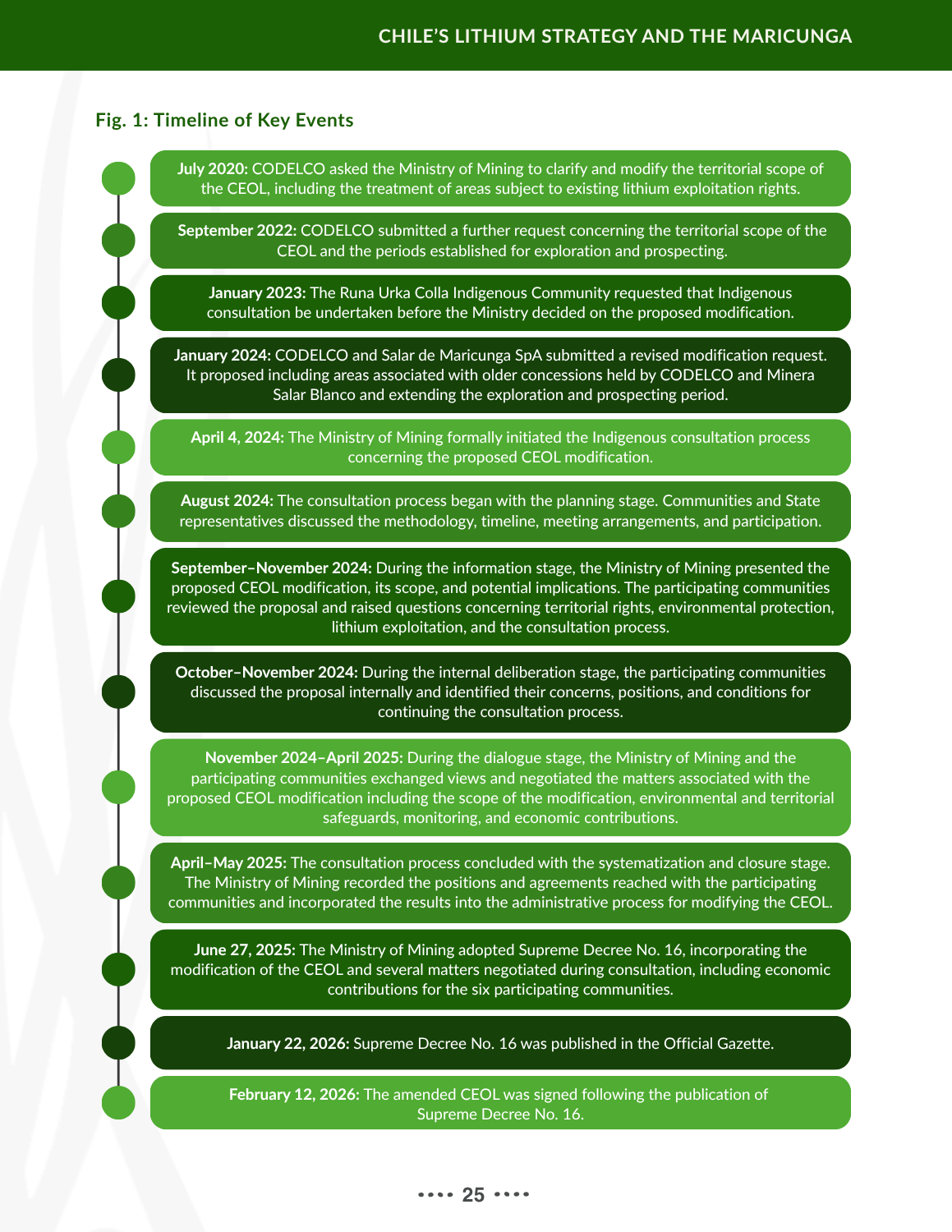
While participating communities achieved meaningful changes to the CEOL in its modification, limitations persist due to the timing and narrow scope of the process, according to the report. The situation “shows why consultation must be assessed across the full sequence of decisions affecting an Indigenous territory, rather than through a single administrative measure viewed in isolation” and “demonstrates that completing formal stages of consultation does not, by itself, establish whether Indigenous Peoples were able to participate through their representative institutions, whether all relevant decisions remained open to their influence, or whether consultation was undertaken in good faith with the objective of achieving agreement or consent on the proposed measure.”
Full implementation of ILO 169 requires Chile, State-owned enterprises and project proponents, investors and supply-chain actors, and Indigenous Peoples’ organizations and civil society to conduct consultations before foundational decisions are adopted to ensure “a scope that reflects connected territorial, environmental, contractual, and project decisions; respect for Indigenous Peoples’ determination of their representative institutions; timely access to information; independent technical and institutional support; and a clear, publicly accessible record showing how agreements reached through consultation are incorporated into final legal obligations.”
Now, under the modified CEOL, “continued scrutiny is needed to determine whether communities receive the promised information and resources, whether monitoring and audits are genuinely independent, whether territorial protections are applied before harm occurs and whether identified breaches lead to enforcement and remedy.”
From the Report
Key Findings
The consultation produced negotiated agreements, several of which were incorporated into the binding conditions governing the modified CEOL.
The consultation took place after foundational decisions concerning the CEOL had already been adopted and was limited to modifying the existing framework.
Agreement on particular safeguards or CEOL clauses should not be treated as consent to the underlying lithium development.
The case reveals the risks of fragmented State decision-making affecting the same territory.
The available record does not establish timely access to relevant documents or community-controlled technical support.
The final decree incorporates several community proposals, but the translation of agreements into binding and implementable obligations remains uneven.
Completion of the formal consultation stages does not, by itself, establish that the full consultation standard was met.
Recommendations for Investors, Strategic Partners, Offtakers and Downstream Companies
Assess the quality and scope of consultation, not merely whether it occurred.
Examine the full sequence of connected decisions.
Review agreements against final legal instruments and subsequent implementation.
Require disclosure of unresolved Indigenous rights concerns.
Use leverage where non-compliance or gaps are identified.
Apply heightened scrutiny to State-led projects.
Priorities for Indigenous Peoples’ Organizations and Civil Society
Support community-controlled documentation and monitoring.
Develop independent technical support networks.
Monitor implementation as well as consultation procedure.
Compare experiences across lithium-affected territories.