
News of Note 6/27/25: Displacement from Indonesia Food Project, Canada’s Controversial Development Bill Passes, Native CDFIs Defunding Threat
Top Stories
UN calls out Indonesia’s Merauke food estate for displacing Indigenous communities (Mongabay)
“U.N. special rapporteurs have raised concerns that Indonesia’s food estate project in Merauke district is displacing Indigenous communities, clearing forests without consent, and using military forces to suppress dissent, threatening more than 50,000 Indigenous people. They point to deforestation of more than 109,000 hectares (269,000 acres), loss of biodiversity, and violations of Indigenous rights, including lack of free, prior and informed consent (FPIC) and intimidation by military forces. [...] NGOs are urging stronger U.N. monitoring, a fact-finding mission, and genuine FPIC processes, warning that the project risks erasing Papuan Indigenous culture while facilitating corporate land grabs.
Carney's 'nation-building' projects bill passes into law — but not without Indigenous pushback (CBC News)
“While the bill was approved by members of the upper house, some senators strenuously opposed it, most of them citing Indigenous rights as the reason. [...] The legislation itself states the government will recognize, affirm and ‘respect’ Indigenous Peoples' constitutional rights when considering a project to fast-track. But there's a fear among some leaders that the consultation process with First Nations, Métis and Inuit communities will be inadequate given Carney campaigned on making final decisions within a two-year timeline. These leaders want protections for what's called ‘free, prior and informed consent’ in the Indigenous legal sphere.”
Double Down on What Works: Invest in Native CDFIs, Don’t Eliminate Them (Native News Online)
The Trump administration plans to claw back $24 million — or 86 percent — of the NACA funds already appropriated for FY 2025. Worse, the president’s FY 2026 budget would scrap NACA altogether. Native CDFIs would be pushed into a new $100 million rural funding pool, where they would go head‑to‑head with CDFIs holding hundreds of millions—even approaching $1 billion—on their balance sheets and unburdened by the trust‑land, jurisdictional, and distance barriers Native lenders navigate daily. On paper, Native CDFIs might qualify. In practice, they wouldn’t stand much of a chance.
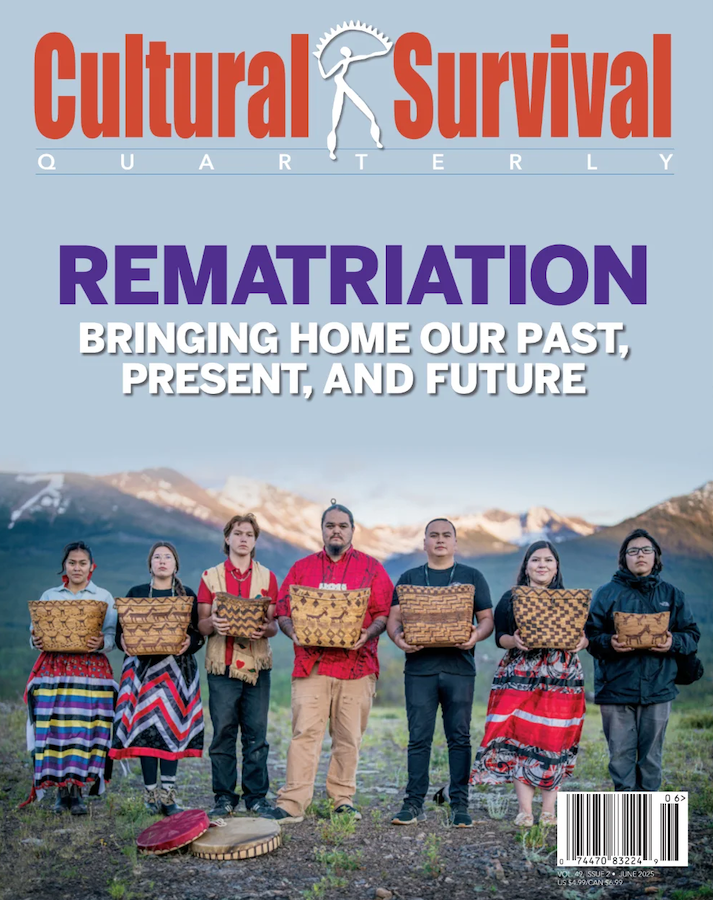
Cultural Survival Quarterly June 2025: Rematriation - Bringing Home our Past, Present, and Future
Corn Sister Circle: Honoring Our Ancestors, Grounded on Our Ancestral Homelands
Rematriation: Restoring Land, Ceremony, and Indigenous Leadership
Naramat Indigenous Women’s Arboretum: Safeguarding Samburu Knowledge in Traditional Medicine
More News
“We are capable of anything”: First Nations leaders unite in Chile to share culture and strength (National Indigenous Times)
Brazil’s Indigenous Akroá Gamella reclaim and restore their land, one patch at a time (Mongabay)
Indigenous people in Pará launch protocol and demand COP30 follow-up (Revista Cenarium) Is ADB transforming its approach to indigenous peoples? (The Jakarta Post)
Moral lessons unlearned: Rio Tinto’s new sacred site controversy (Lens/Monash University)
Bullets and Beatings Are Business as Usual for Canadian Mines (Cultural Survival)
In Norway, Climate Goals Clash With Indigenous Herders’ Rights (Columbia Climate School) Indonesia: Presidential visit for new EV battery factory is “a disaster for uncontacted Indigenous people” (Survival International)
Survey finds 'significant' rise in racism towards Indigenous people in past decade (Australia Broadcasting Corporation)
Here’s what you need to know about Indigenous sovereignty [Canada] (The Narwhal)
In Uncertain Times, Tribes Provide Steady Protection for Clean Water (NRDC)
Bills 5 and C-5 spur Six Nations teach-in on Haudenosaunee rights (CBC News)
Indigenous guards: The shield of Colombia’s Amazon (Mongabay)
In rural Alaska, a village turns to solar and biomass energies to cut diesel and save money (Associated Press)
UNESCO appoints Indigenous co-chairs to protect languages and knowledge amid climate crisis (Grist)