
News of Note 1/23/26: DRC Minerals Mining Threats, BC to Scale Back Indigenous Rights Law, Indigenous Women Drive Economies in Bangladesh
Top Stories
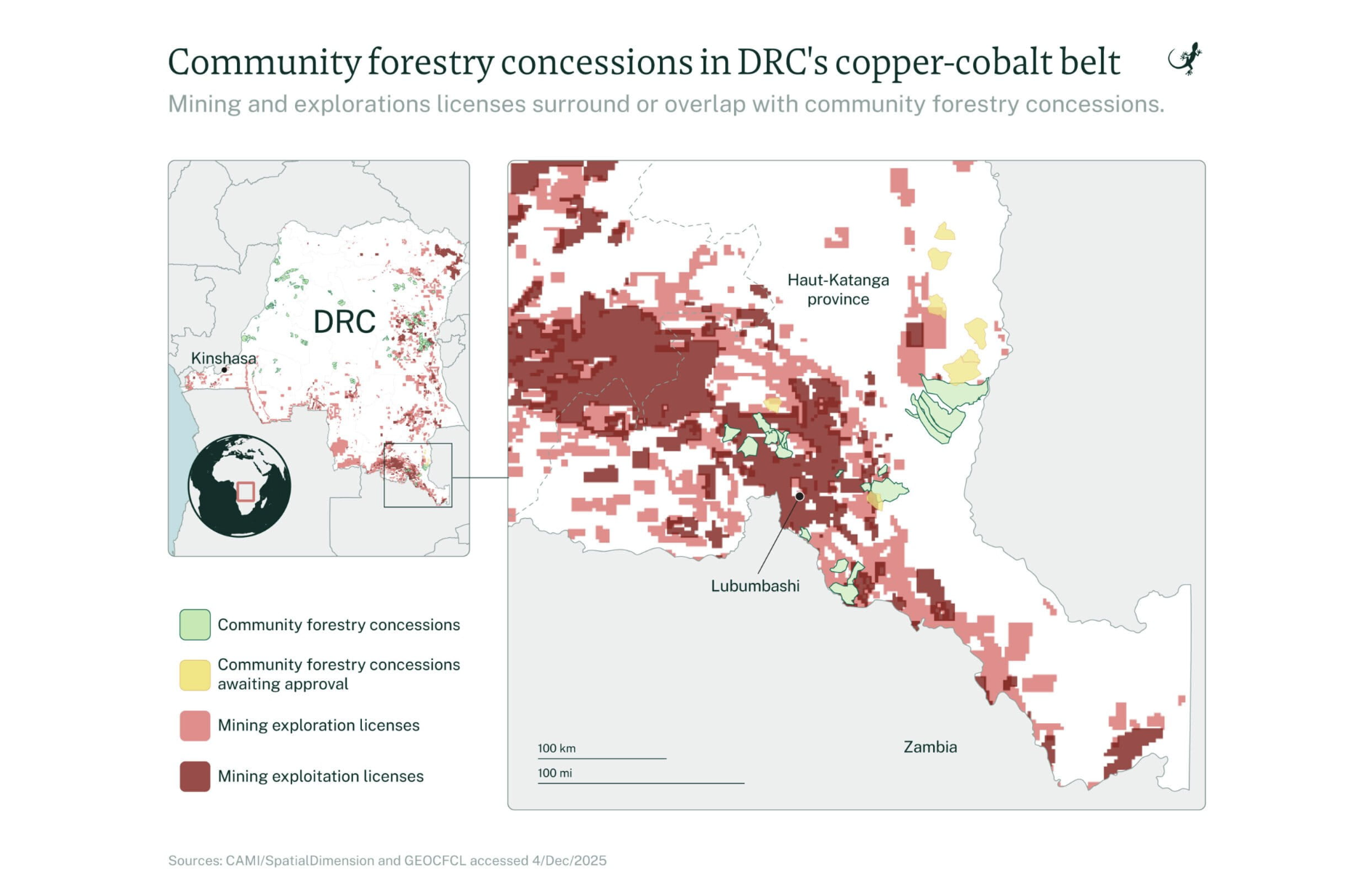
In the race for DRC’s critical minerals, community forests stand on the frontline (Mongabay)
“In the Democratic Republic of the Congo’s copper-cobalt belt, a region rich in critical minerals, villagers are turning to local community forest concessions (CFCLs) to prevent their eviction and conserve the remaining savanna forests in the face of mining expansion. This is an area where miners from the DRC, China, the U.S. and elsewhere are searching for the minerals powering the high-tech, weapons and clean energy industries. Community forest concessions offer communities land titles in perpetuity and have environmental management plans led by Indigenous and local communities with the support of environmental NGOs and donors. But these concessions are not a perfect solution against deforestation or the eviction of communities by mining, and also suffer from a lack of funding to support all their environmental efforts.”
B.C. will revise DRIPA legislation to scale back court power over Indigenous rights, Eby says (CBC News)
“B.C. Premier David Eby says his government will be amending the Declaration on the Rights of Indigenous Peoples Act (DRIPA) to scale back the power courts have in shaping reconciliation efforts in the province. [...] following a firestorm of controversy sparked by a B.C. Supreme Court decision this past summer awarding the Quw'utsun (Cowichan) Nation title this summer to between 300 and 325 hectares of land. Around 150 pieces of private property in Richmond, B.C., are situated on that parcel of land. While the Quw'utsun have explicitly stated they have no intention of pursuing land owned by private owners, the case is viewed as one of the more consequential in the history of Indigenous rights and title in B.C.”
Indigenous Women Driving Economic and Social Change in Bangladesh (Cultural Survival)
“Indigenous women in remote areas of Bangladesh uphold traditional values while contributing to their families and the nation's broader society in their own way. Their presence is now everywhere, including education, literature, culture, the economy, and community development. Yet, their struggles and contributions remain unrecognized.”
More News
OPEN LETTER: Justice for Quinto Inuma: International organisations call for an end to violence and impunity against Indigenous human rights defenders in Peru (Front Line Defenders)
Nigeria Must Protect Forest Defenders and Halt Illegal Logging in Ekuri Forest (Global Forest Coalition)
Indonesia revokes forest and mine permits over role in deadly Sumatra landslides (Mongabay)
Defining self-determination amid state constraints: Lessons from Lupaka Gold v. Peru International (Institute for Sustainable Development)
Watchdog reveals Indigenous people still face barriers in accessing financial services [Australia] (National Indigenous Times)
Community is Everything Australia Invasion Day 2026 Activist Toolkit (Amnesty International)
Torres Strait leaders call for Sea Country rights to be recognised in law (National Indigenous Times)
Clean Grid, Renewables Account for 85% of Energy Projects with Indigenous Ownership [Canada] (The Energy Mix)
Assembly of First Nations warns members to be cautious in U.S. following ICE actions (The Canadian Press)
Gwich’in Steering Committee, allied groups take latest Arctic Refuge leasing program to court (Trustees for Alaska)
Tribes Seek Better Data, Real Accountability in MMIP Cases Ahead of Tribal Consultation (Native News Online)
Prairie Island Indian Community reaches halfway point on net zero carbon emissions project (Tribal Business News)
Indigenous-led conservation efforts match or surpass similar initiatives when properly funded, new research shows (Concordia University)
Treating data like land — data sovereignty in the AI age (ICT News)
Photo via Cultural Survival.