
Just Transition and Indigenous Rights Panel at NYC Climate Week
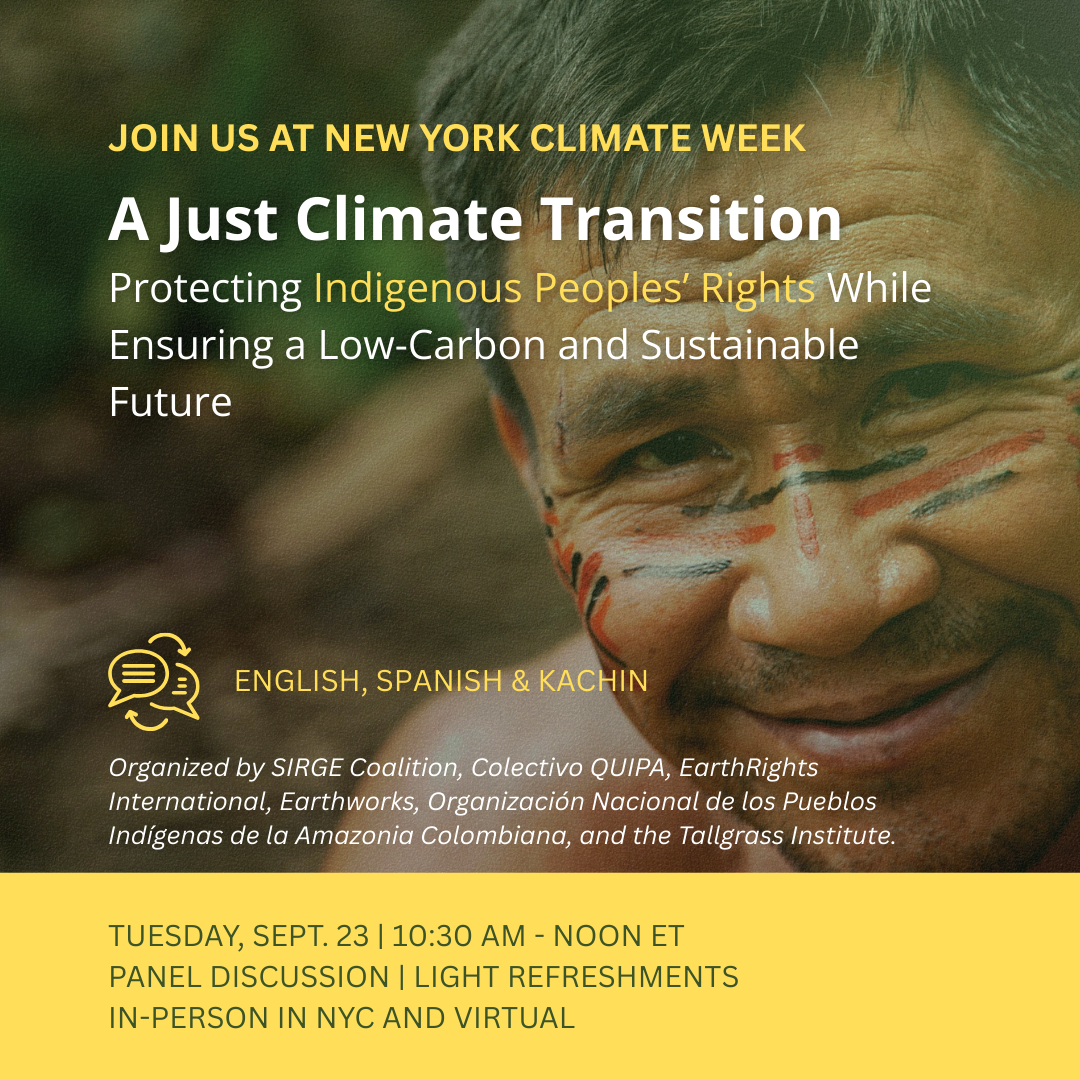
Indigenous Peoples are on the frontlines of the climate crisis and are leading the way toward actionable solutions in the energy transition. From Myanmar, where devastating heavy rare earth element (HREE) extraction is advancing without consent, to the Amazon, where leaders are declaring No-Go Zones as a rights-first model, Indigenous voices are exposing risks and advancing alternatives.
On Tuesday, September 23, A Just Climate Transition - Protecting Indigenous People's Rights While Ensuring a Low-Carbon and Sustainable Future invites policymakers, funders, end users, and allies to stand with Indigenous leaders in making Free Prior and Informed consent (FPIC), land rights, and Indigenous Peoples' sovereignty non-negotiable in climate action — and to help move from extractive models toward a just and sustainable energy transition.
Speakers:
Elisa Morgera, UN Special Rapporteur on Climate and Human Rights
Indigenous Peoples representative of Kachin
Ginny Katherine Alba Medina, Technical Secretary of the Human Rights Commission – Adviser to the National Organization of the Indigenous Peoples of the Colombian Amazon – (OPIAC)
Indigenous Peoples representative of Indonesia
Jennifer Krill, Executive Director, Earthworks
Galina Angarova (Moderator), Executive Director, SIRGE Coialtion
The panel discussion takes place 10:30 am through Noon ET. Attendees can partipcate online via Zoom or in-person (deails to come). Register here.
Organized by Colectivo QUIPA, EarthRights International, Earthworks, Organización Nacional de los Pueblos Indígenas de la Amazonia Colombiana, SIRGE Coalition, and Tallgrass Institute.
Related Events
From Resource Curse to Resource Justice: Women’s Perspectives on Shared Prosperity in the Energy Transition
Monday, September 22, 2025, 2:00-3:30 pm ET
What does justice mean in the context of an energy transition from fossil fuel phase-out to renewable energy? How can the benefits and burdens of the natural resource value chain, upon which this transition depends, be shared equitably? And how can we ensure that populations in countries that depend on oil and gas extraction are not left behind in the transition? Panelists, including Global South leaders at the frontline of resource extraction, as well as labour, trade and finance experts, will discuss strategies to overcome systemic barriers and achieve a just energy transition. Registration and more information.
Justice in Motion: Rethinking Mobility to Reduce Mining and Uphold Rights
Tuesday, September 23, 2025, 2:30 - 4:00 pm ET
This interactive gathering will bring together civil society, Indigenous Peoples, researchers, and frontline community advocates to explore personal mobility solutions that reduce harm and reclaim justice. We will discuss how transforming the transport sector—particularly by shifting away from private car ownership and increasing corporate accountability—can significantly reduce demand for transition minerals and limit negative impacts on people and the environment. Registration and more information.