Poor Indigenous Peoples’ Rights Due Diligence Still Impedes the Auto Industry’s Rights-respecting Potential
To Progress, Automakers Must Operationalize FPIC and Accelerated Respect for Indigenous Peoples’ Rights
Lead the Charge published its fourth annual leaderboard on automotive supply chains, which evaluates efforts by 18 leading global automakers to eliminate emissions, environmental harms, and human rights violations, including Indigenous Peoples’ rights, among 88 indicators.
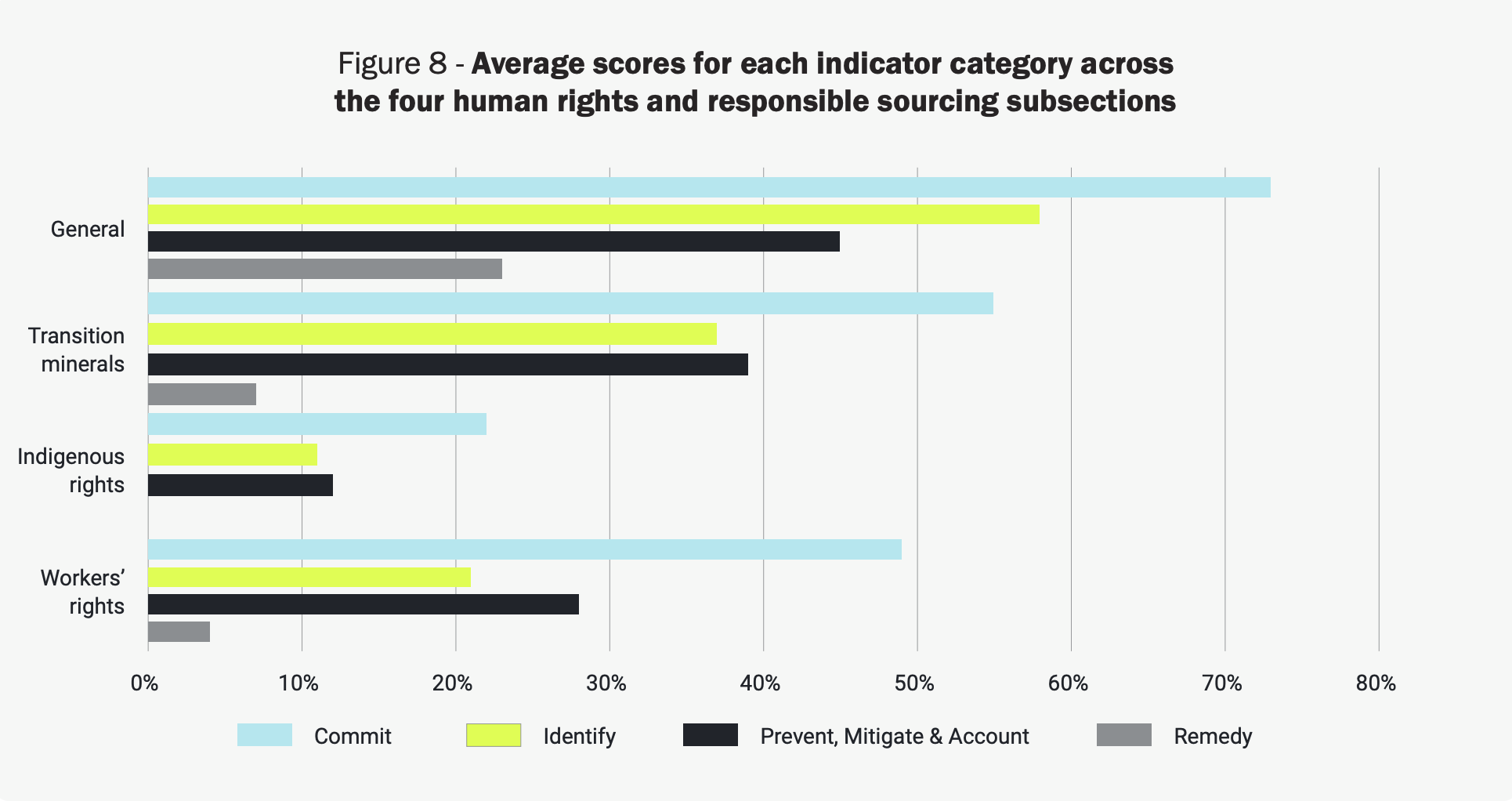
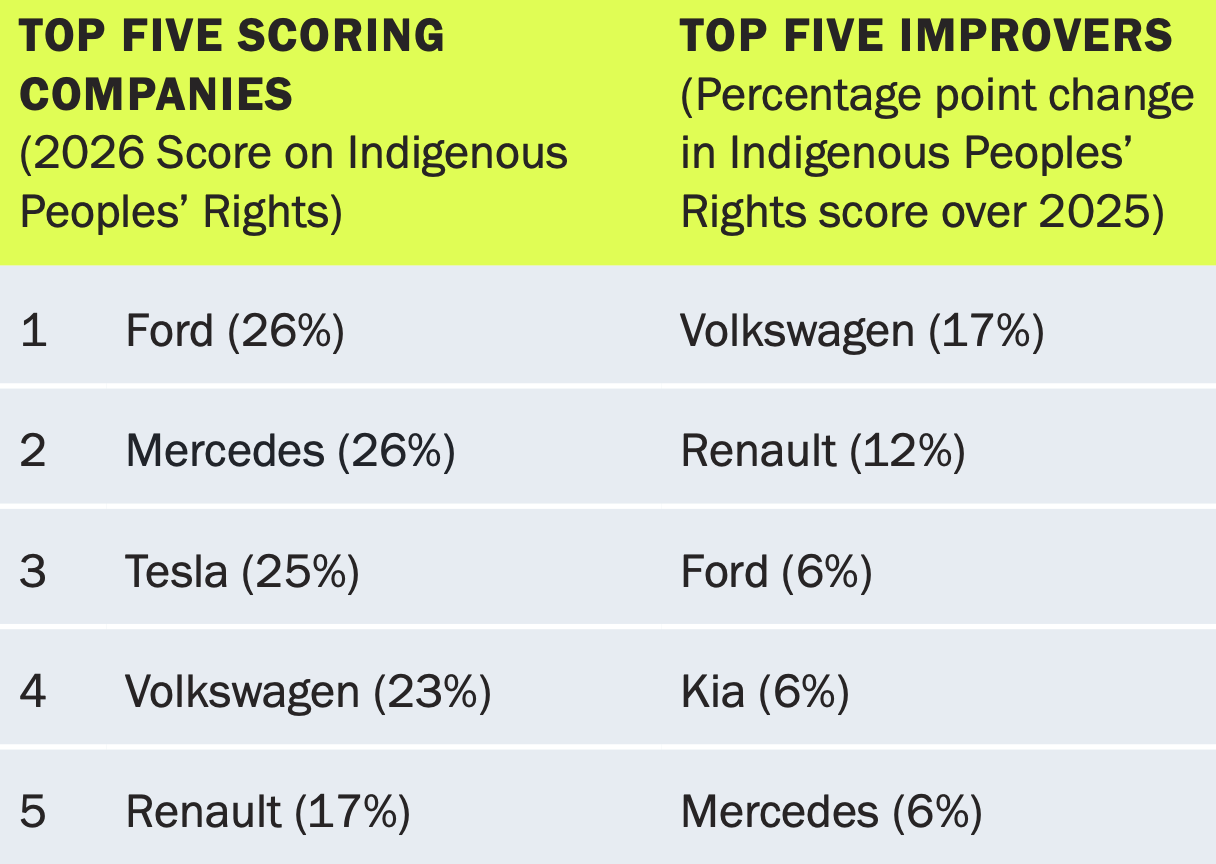
The average achievement for Indigenous Peoples’ rights remained unacceptably low at just 9%, up from 6% from last year, with top-scoring companies being Ford (26%), Mercedes (26%), Tesla (25%), Volkswagen (23%), and Renault (17%). Nissan, Honda, BYD, Toyota, GAC and SAIC were lowest achievers, scoring zero.
The report acknowledged slow progress on Indigenous Peoples’ rights year-over-year, but noted the 2026 leaderboard saw the largest number of evaluated companies making improvements since the leaderboard first launched in 2023. Automakers taking initial steps on Indigenous Peoples’ rights were in the majority (12 out of 18) for the first time, and half of the companies improved their scores from last year.
Galina Angarova, Executive Director of the Securing Indigenous Peoples’ Rights in the Green Economy (SIRGE) Coalition, which is a member of the Lead the Charge campaign, acknowledged the modest but meaningful progress on Indigenous Peoples’ rights.
“While overall scores remain low, eight automakers improved their performance, and the sector’s average score rose by three percent compared to last year, signaling growing recognition of Indigenous Peoples’ rights at the policy level,” she said.
Practical implementation of existing commitments is “scarce,” according to the report:
A few more automakers described procedures and steps to operationalise commitments in this area, but these remain basic. Information about Indigenous Peoples’ participation in risk assessments and remedial processes is completely absent, and the majority of automakers are still failing to disclose practical information regarding direct engagement with extractive companies and/or Indigenous Peoples to address and resolve concerns. The fact that these are the same issues automakers have failed to report on for the last three years shows a general and consistent disregard for Indigenous Peoples’ rights.
“Across supply chains and transition mineral mining, concrete implementation lags far behind corporate policy statements,” said Angarova, noting that the auto industry must pivot from recognizing rights to respecting them fully in their operations. “The SIRGE Coalition will continue pressing automakers to demonstrate meaningful implementation, accountability, and respect for Indigenous Peoples’ rights where impacts are occurring."
This year, indicators on Indigenous Peoples’ rights were expanded to include involvement of Indigenous Peoples in due diligence processes, as well as processes for operationalizing free, prior and informed consent (FPIC) requirements and addressing FPIC breaches.
However, as Edson Krenak, Brazil Program Manager at Cultural Survival, which is a member of Lead the Charge and the SIRGE Coalition, notes "this positive expansion of Indigenous indicators has shown not only gaps in the operationalization of FPIC, but a flawed understanding of Indigenous Peoples' rights that are still treated as policy language or a tool to be checked and displayed as non-enforceable conditions.” According to Krenak, “Without binding contract clauses, traceability, independent verification, remedy, and full participation of Indigenous affected communities, FPIC remains optional in practice."
Among other concerns, the report shows that only four automakers expressly commit to the UN Declaration on the Rights of Indigenous Peoples (UNDRIP), including Tesla, Ford, GM, and Renault; only two companies, Volkswagen and Mercedes, disclose where in the supply chain Indigenous Peoples’ risks exist; and no automaker meets criteria for grievance mechanisms for potentially affected rightsholders or discloses grievance data, such as type, severity, tier, and geographical location, of impacts.
Auto supply chains that violate Indigenous Peoples' rights pose considerable financial and operational risks to automakers, and projects that proceed without FPIC expose companies to legal, reputational, and further financial risks. For electric vehicle manufacturers, Indigenous Peoples’ rights due diligence is critical; at least 54% of minerals used for the energy transition and battery technologies are located on or near Indigenous Peoples’ territories.
“Since Lead the Charge’s leaderboard was first published, we have witnessed in real time the automotive industry address Indigenous Peoples' risk criteria,” said Kate R. Finn, Founder & Executive Director of Tallgrass Institute, and Chair of the SIRGE Coalition Executive Committee. “While some automakers are building or improving policy in incremental steps, much more progress needs to happen quickly as impacts to Indigenous Peoples’ lands are accelerating with the energy transition and mining for new technologies. We call on all companies to be swift and comprehensive when implementing due diligence to avoid Indigenous Peoples’ rights violations at all points in their supply chains and manufacturing processes.”
Originally published at sirgecoalition.org.