Indigenous Peoples and the 2026 AGM Season
Excepted from Tallgrass Institute’s report Indigenous Peoples and the 2026 AGM Season.
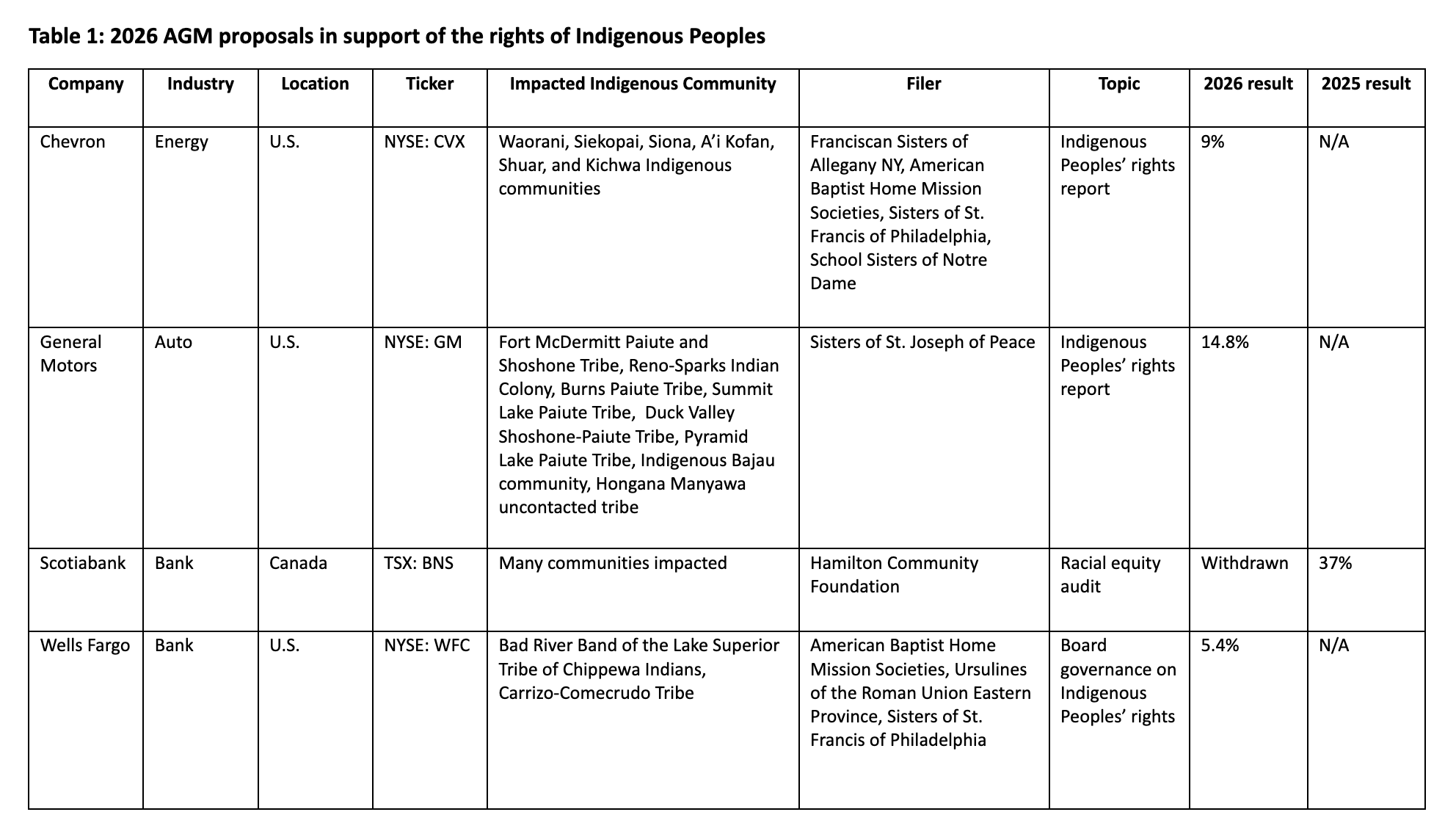
During the 2026 annual general meeting (AGM) season, investors filed four shareholder proposals regarding the rights of Indigenous Peoples. This report reviews these four proposals involving companies in the banking, mining, energy, and automotive sectors. Although the number of new proposals declined compared with previous years, these proposals continued to address the right to free, prior and informed consent (FPIC), racial equity audits that include assessments of corporate impact on Indigenous Peoples, and corporate accountability for the impacts of financing, operations, and supply chains on Indigenous communities.
Across the 2026 AGM season, regulatory changes in the United States created an unusual environment for both companies and shareholder proponents. As other analysts have noted, the 2026 U.S. AGM season had fewer shareholder proposals compared to 2025 and took place amid a changing regulatory environment that witnessed a significantly reduced role for the Securities and Exchange Commission (SEC) in providing substantive responses to Rule 14a-8 no-action requests. Following changes at the SEC, a greater share of proposals filed made it to a vote compared to 2025. However, when shareholder proposals related to environmental, social, or governance (ESG) issues came to a vote, there was less support compared to previous years.
Canadian shareholder engagement on Indigenous Peoples’ rights and racial equity has frequently resulted in negotiated withdrawals rather than votes. In recent years, these agreements have led companies to commit to racial equity audits that include an assessment of corporate impact on Indigenous Peoples, Reconciliation Action Plans, and reviews of policies and practices impacting Indigenous Peoples’ rights. The sole 2026 Canadian proposal continued this pattern.
However, commitments are not the final stage. Indigenous Peoples utilize a wide array of strategies to engage with companies such as public policy advocacy, legal work, organizing and protests, and working with investor allies to meet with companies and filing shareholder proposals to bring issues to a wider investor audience. Several commitments remain underway, with the extent and quality of public reporting varying considerably among companies. A new feature of this report contains a review of commitments made following the withdrawal of shareholder proposals during the 2023, 2024, and 2025 AGM seasons.
[...]
Looking back over the past four years and with the new proposals filed in 2026, shareholder strategies are generating clear momentum towards corporate accountability to Indigenous Peoples that goes beyond compliance and towards shifting policy commitment into policy implementation. Several ongoing engagements are now focused on quality of reporting that includes both project-level and company-wide assessments of exposure to risk from lack of respect for Indigenous Peoples’ rights. These proposals demonstrate to company leadership the critical importance of prioritizing robust due diligence that goes above a jurisdictions’ legal and environmental policies, and resourcing engagement strategies with Indigenous Peoples founded in respect for free, prior and informed consent as enumerated in the UN Declaration on Indigenous Peoples Rights.
In a landscape, particularly in the United States, with fewer sustainability and ESG-related proposals going to a vote, these proposals hold a firm line against dilution of past commitments and to ensure that progress towards full respect for Indigenous Peoples has a clear and actionable pathway forward. As companies move in ever-closer proximity to Indigenous Peoples, whether to their lands, territories and waters, or their languages and cultural property, investor strategies are a critical way to bring visibility to rights-aligned engagements with Indigenous Peoples and to respect their human rights.