
AI opportunities for Indigenous Peoples – from tracking wildfires and climate impact predictions to rural health advancement and language preservation – are tempered by incoming threats. These can include water and land degradation, community displacement, and digital extraction of culture and traditional knowledge without consent.
To avoid these harms, AI development must center respect for Indigenous Peoples’ sovereignty and integrate Indigenous leadership and priorities throughout design and implementation.
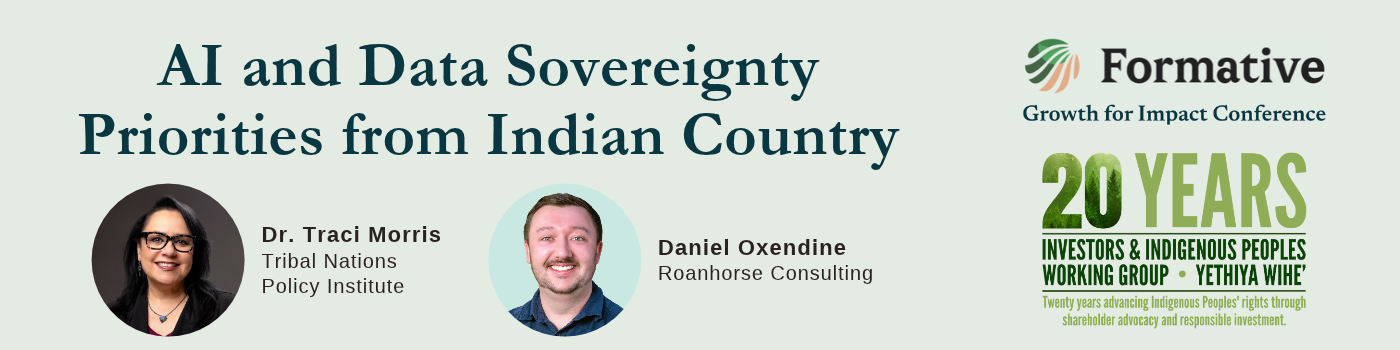
The expert panel, AI and Data Sovereignty Priorities from Indian Country, presented at the Growth for Impact Conference on November 10, provided investors with definitions and risk frameworks from research into Native Nations' priorities for AI, data, and digital infrastructure. Hosted by the Investors & Indigenous Peoples Working Group (IIPWG), with support from Tallgrass Institute, the panel furthered IIWPG’s 20 years of advancing Indigenous Peoples’ rights in responsible investment.
Tribal Digital Sovereignty and Values-Alignment in AI Development
Dr. Traci Morris, Executive Director of Tribal Nations Policy Institute (TNPI), distinguished data sovereignty from Tribal digital sovereignty, an expansive definition of how sovereign Indigenous Nations govern their data, models, codes, contracts, data centers, and their digital landscape.
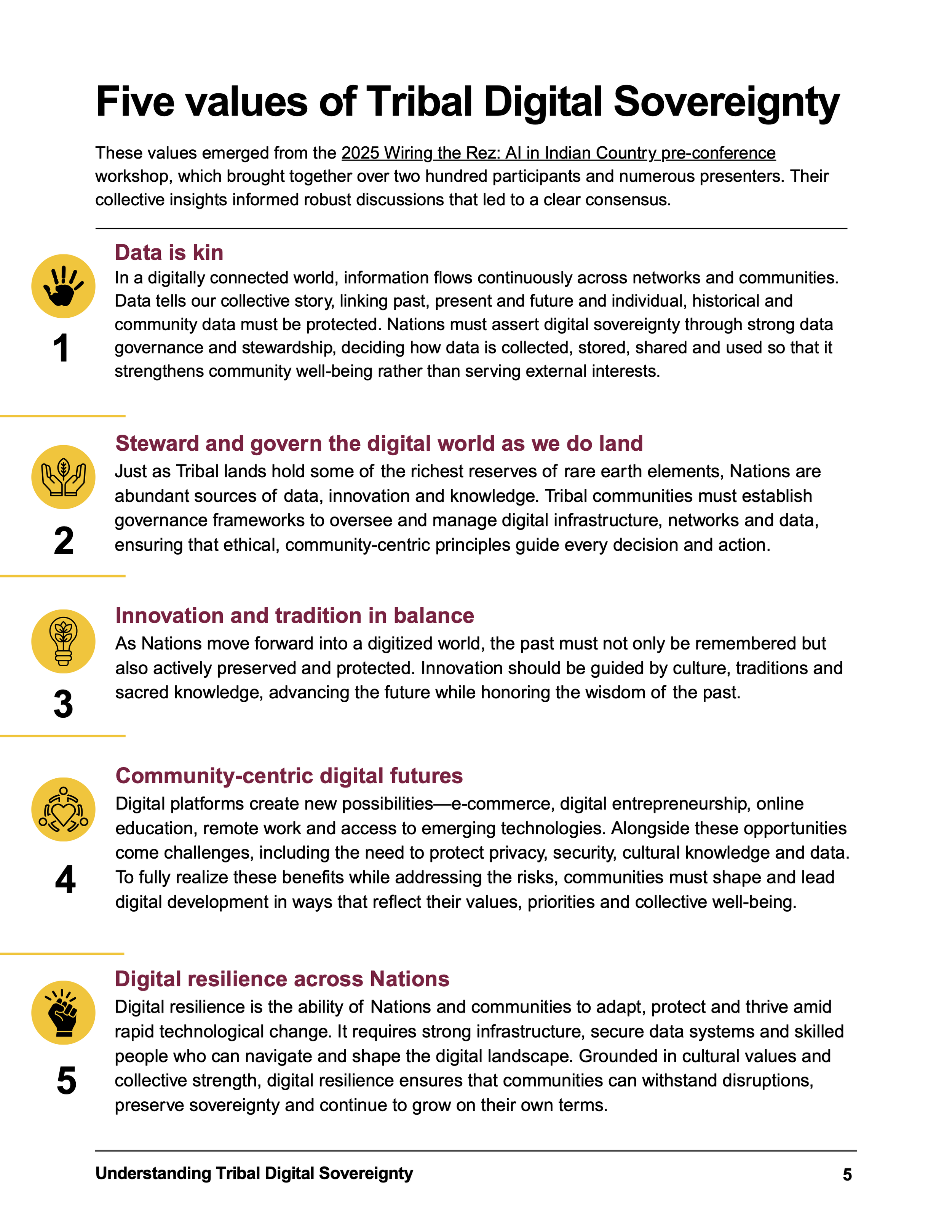
There are 575 federally recognized Tribes in the U.S. and, thus, there can be as many different approaches to AI. Morris highlighted key values captured in TNPI’s Tribal Digital Sovereignty Guide Book that help to understand Tribes’ expectations and priorities. Among these values:
Data as kin reflects how Tribes hold duty to their kin as relatives; the question of how they care for their kin can be applied to data governance and compliance.
Stewarding and governing the digital world as Tribes do the land applies self-determination to all areas of AI and digital development, strengthening consultation standards and integrating free, prior and informed consent (FPIC) where there are impacts.
And Digital resilience across Nations encompasses how Tribes adapt, protect their communities, and thrive in AI development.
Investors can integrate these values when screening portfolios and to strengthen due diligence for social, governance, and land and resource risk in AI projects. Key questions investors can ask to frame due diligence around Tribal sovereignty include whose land and water are being used, what are the jurisdictional ramifications for projects, and how are projects and partnerships governed.
Engagement and Co-Designing with Tribes
Daniel Oxendine, Research and Evaluation Associate at Roanhorse Consulting, discussed his research on Indigenous technology futures, sharing what Tribal-led digital ecosystems look like and how investors can connect project development with best practices for community engagement.
Because each Nation has its own governance structure, Oxendine recommended investors come into community with a willingness to learn. He shared three areas to prioritize early in engagement:
Relationship: Relationships come before the work can begin and are built at the speed of trust; allow the time and resources needed to build these relationships.
Reciprocity: When asking communities to share their knowledge and histories, investors should consider what they are giving back. People should be compensated for their time and expertise. Especially important for AI is how data is being returned to communities and how it serves their priorities.
Leading with Sovereignty: Centering Tribal sovereignty in all conversations means understanding that all Tribes have their own authority and decision-making processes. This has a critical role in how Tribes’ data, knowledge, and water and energy resources are used.
Oxendine also recommended approaching Tribes not with fully formed projects but rather with opportunities to co-create. This allows Tribes to define questions and parameters, identify priorities, and ultimately shape what success looks like. Questions surfacing from Tribes about AI-related projects include potential impacts and benefits from infrastructure, who owns and controls data, who benefits from outcomes, and what safeguards are in place or need to be considered. All have implications for Tribal sovereignty.
Financial Managers as a Last Line of Defense for Tribal Sovereignty

Dr. Morris discussed how financial managers can be a last line of defense to protect sovereignty. Because AI arrives through contracts where tribal jurisdiction can be written in or lost, financial managers can enforce integration of community values before signing those contracts.
Kate R. Finn, Founder and Executive Director of Tallgrass Institute, who moderated the panel, noted that the data that that AI analyzes and uses is often deficient, racist, and modeled on pervasive inequities. Similarly, land, water, and energy use for AI data centers rely on extractive patterns and practices that harm or otherwise negatively impact Indigenous Peoples. This means portfolio management requires responsible investment stewards to take an explicitly Indigenous view to verify data independently.
Investors should take an active approach to integrate Indigenous leadership as they assess how AI will interact with their portfolio for the highest level of risk due diligence and to ensure Indigenous Peoples’ participatory power. The Tribal Nations Policy Institute and Roanhorse Consulting are two leaders among the abundance of expertise and resources from Indian Country working to create sovereignty-aligned digital futures.
Additional Resources
Center for Tribal Digital Sovereignty | Tribal Nations Policy Institute
DataCenter Tracker On or Near Indigenous Lands | Honor the Earth
Avoiding the next digital divide: Defining digital sovereignty for Tribal Nations in the AI age | The Brookings Institute
Proactive Solutions in Implementing Tribal Digital Sovereignty | The Journal for Community Informatics
Operationalizing the CARE and FAIR Principles for Indigenous data futures | Nature Scientific Data
Indigenous Peoples and the Mineral Footprint of Artificial Intelligence | SIRGE Coalition, Tallgrass Institute
Indigenous Peoples and artificial intelligence – study | United Nations Permanent Forum on Indigenous Issues